# Draw Points on a Mesh Surface
> Helpful code snippet for drawing points on a mesh surface in Babylon.js.
Source: https://doc.babylonjs.com/toolsAndResources/utilities/SurfaceMeshPoints
## How To Create Points on the Mesh Surface
This utility enables you to create and store Vector3 points, each of which is positioned uniformly at random on the surface of a mesh.
## Design Outline
1. Take a random triangular facet belonging to the mesh;
2. Calculate the area of the triangle;
3. Calculate the number of random points to place on the facet using density * area;
4. Choose random points inside this triangle;
## Design Method
For the mesh, get the vertex positions and indices using
```javascript
var positions = mesh.getVerticesData(BABYLON.VertexBuffer.PositionKind);
var indices = mesh.getIndices();
```
For each facet, F, obtain the three facet vertex positions, vertex0, vertex1, and vertex2 using the positions array. From these, construct vectors, vec0, vec1, and vec2 along each side of the triangle. Using the lengths of the sides, calculate the area of the triangle. For a value 0 ≤ λ ≤ 1, λvec0 and λvec1 form two sides of a triangle similar to the facet. So, when also given a value 0 ≤ μ ≤ 1, λvec0 and λμvec1 give a point inside the facet. The range of values for λ and μ determines all points within the facet. Hence, random values for λ and μ give random points on the facet plane.
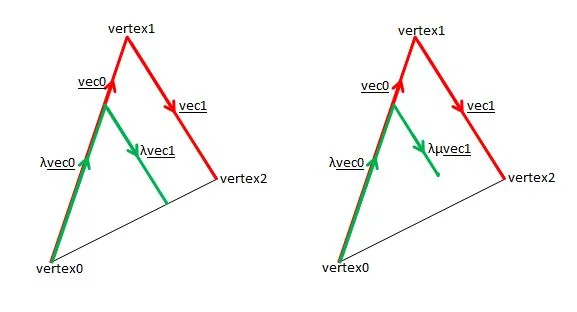
```javascript
lamda = BABYLON.Scalar.RandomRange(0, 1);
mu = BABYLON.Scalar.RandomRange(0, 1);
facetPoint = vertex0.add(vec0.scale(lambda)).add(vec1.scale(lambda * mu));
```
Repeat this for density * area random points on each facet.
## The Whole Function
Set the point density, then generate, store, and return the points in an array.
```javascript
BABYLON.Mesh.prototype.createSurfacePoints = function(pointDensity) {
var positions = this.getVerticesData(BABYLON.VertexBuffer.PositionKind);
var indices = this.getIndices();
var point = BABYLON.Vector3.Zero();
var points = [];
var randX = 0;
var randY = 0;
var randZ = 0
var index = 0;
var id0 = 0;
var id1 = 0;
var id2 = 0;
var v0X = 0;
var v0Y = 0;
var v0Z = 0;
var v1X = 0;
var v1Y = 0
var v1Z = 0;
var v2X = 0;
var v2Y = 0;
var v2Z = 0;
var vertex0 = BABYLON.Vector3.Zero();
var vertex1 = BABYLON.Vector3.Zero();
var vertex2 = BABYLON.Vector3.Zero();
var vec0 = BABYLON.Vector3.Zero();
var vec1 = BABYLON.Vector3.Zero();
var vec2 = BABYLON.Vector3.Zero();
var a = 0; //length of side of triangle
var b = 0; //length of side of triangle
var c = 0; //length of side of triangle
var p = 0; //perimeter of triangle
var area = 0;
var nbPoints = 0; //nbPoints per triangle
var lamda = 0;
var mu = 0;
for(let index = 0; index