# Create Points Inside A Mesh
> Helpful code snippet for creating points inside a mesh in Babylon.js.
Source: https://doc.babylonjs.com/toolsAndResources/utilities/InnerMeshPoints
## How To Create Points Inside a Mesh
This utility enables you to create and store Vector3 points, each of which is randomly positioned inside a given mesh.
## Design Outline
1. Take a random triangular facet belonging to the mesh;
2. Choose a random point inside this triangle;
3. For the facet construct an inward pointing random vector;
4. Using that point as ray origin and the vector as ray direction find the hit point of the ray on the mesh;
5. Determine a random point on the line segment joining the origin point to the hit point.
## Design Method
1. For the mesh, get the vertex positions and indices using
```javascript
var positions = mesh.getVerticesData(BABYLON.VertexBuffer.PositionKind);
var indices = mesh.getIndices();
```
Select a facet, F, at random.
2. Obtain the three facet vertex positions, vertex0, vertex1, and vertex2 using the positions array. From these, construct vectors, vec0 and vec1, along two sides of the triangle, one following the other. For a value 0 ≤ λ ≤ 1, λvec0 and λvec1 form two sides of a triangle similar to the facet. So, when also given a value 0 ≤ μ ≤ 1, λvec0 and λμvec1 give a point inside the facet. The range of values for λ and μ determines all points within the facet. Hence, random values for λ and μ give random points on the facet plane.
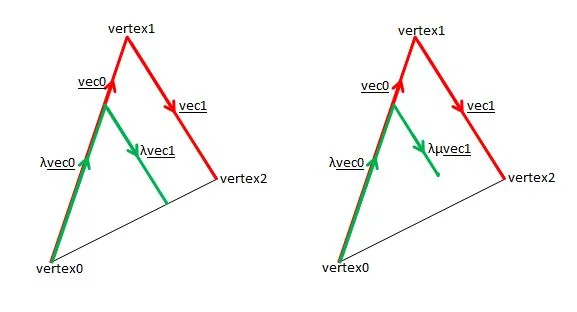
```javascript
lamda = BABYLON.Scalar.RandomRange(0, 1);
mu = BABYLON.Scalar.RandomRange(0, 1);
facetPoint = vertex0.add(vec0.scale(lambda)).add(vec1.scale(lambda * mu));
```
3. To generate a vector pointing inward, get the normal vector of the facet, which points outward, and reverse it to get the vector n. Use t = vec0 as one vector in the plane and b, the cross product of the normal and vec0, as the other. For an angle 0 ≤ θ ≤ 2π, f = tcos(θ) + bsin(θ) gives a vector in the facet plane. For an angle 0 ≤ φ ≤ π, fcos(φ) + nsin(φ) gives a vector whose direction is toward the inside of the mesh.
```javascript
mesh.updateFacetData(); // needed to use getFacetNormal
norm = mesh.getFacetNormal(index).normalize().scale(-1);
tang = vec0.clone().normalize();
biNorm = BABYLON.Vector3.Cross(norm, tang);
angle = BABYLON.Scalar.RandomRange(0, 2 * Math.PI);
facetPlaneVec = tang.scale(Math.cos(angle)).add(biNorm.scale(Math.sin(angle)));
angle = BABYLON.Scalar.RandomRange(0.1, Math.PI);
direction = facetPlaneVec.scale(Math.cos(angle)).add(norm.scale(Math.sin(angle)));
```
4. Construct a ray using the facet point, the direction, and a distance equal to the diameter of the mesh's bounding sphere. This ensures it is long enough to hit another facet of the mesh and find the hit point.
```javascript
var boundInfo = mesh.getBoundingInfo();
var diameter = 2 * boundInfo.boundingSphere.radius;
var ray = new BABYLON.Ray(facetPoint, direction, diameter);
var hitPoint = ray.intersectsMesh(mesh).pickedPoint;
```
5. Take a random fraction, 0 ≤ r ≤ 1, of the distance between the hit point and the facet point, and use this to determine the position of a point along this line. Use facetPoint + r(hitPoint - facetPoint) to determine a point within the mesh.
```javascript
var ray = new BABYLON.Ray(facetPoint, direction, diameter);
var pickInfo = ray.intersectsMesh(this);
if (pickInfo.hit) {
var distance = pickInfo.pickedPoint.subtract(facetPoint).length();
var gap = BABYLON.Scalar.RandomRange(0, 1) * distance;
var point = facetPoint.add(direction.scale(gap));
}
else { // just in the rare case the facet point randomly chosen is on the adjoining axis of two concave meeting facets
point.set(0, 0, 0);
}
```
## The Whole Function
Set how many interior points to generate, then store and return them in an array.
```javascript
BABYLON.Mesh.prototype.createInnerPoints = function(pointsNb) {
var boundInfo = this.getBoundingInfo();
var diameter = 2 * boundInfo.boundingSphere.radius;
this.updateFacetData();
var positions = this.getVerticesData(BABYLON.VertexBuffer.PositionKind);
var indices = this.getIndices();
var point = BABYLON.Vector3.Zero();
var points = [];
var directions = [];
var randX = 0;
var randY = 0;
var randZ = 0
var index = 0;
var id0 = 0;
var id1 = 0;
var id2 = 0;
var v0X = 0;
var v0Y = 0;
var v0Z = 0;
var v1X = 0;
var v1Y = 0
var v1Z = 0;
var v2X = 0;
var v2Y = 0;
var v2Z = 0;
var vertex0 = BABYLON.Vector3.Zero();
var vertex1 = BABYLON.Vector3.Zero();
var vertex2 = BABYLON.Vector3.Zero();
var vec0 = BABYLON.Vector3.Zero();
var vec1 = BABYLON.Vector3.Zero();
var lamda = 0;
var mu = 0;
var norm = BABYLON.Vector3.Zero();
var tang = BABYLON.Vector3.Zero();
var biNorm = BABYLON.Vector3.Zero();
var angle = 0;
var facetPlaneVec = BABYLON.Vector3.Zero();
var gap = 0;
var distance = 0;
var ray = new BABYLON.Ray(BABYLON.Vector3.Zero(), BABYLON.Axis.X);
var pickInfo;
var facetPoint = BABYLON.Vector3.Zero();
var direction = BABYLON.Vector3.Zero();
var particleDirection = BABYLON.Vector3.Zero();
var particleDistance = 0;
var testPoint = BABYLON.Vector3.Zero();
for(let p = 0; p