Issues Arising When Getting Particles To Collide
Checking for an Intersect
One way to check in Babylon.js whether two meshes are colliding is to use the intersectsMesh method. So, for Fig 1,
sphere.intersectsMesh(wall)would give the result true

Fig 1
You may think that when the sphere in Fig 2 is travelling towards the wall, you could use
if(sphere.intersectsMesh(wall)) { //bounce sphere off wall}else { //move sphere left}
Fig 2
However, consider the sphere as having unit diameter and moving towards the wall with a speed of 5 units per frame. The collision check has to be considered for each frame. The first frame is as in Fig 3 and the next frame is as in Fig 4.
Fig 3
The sphere will have gone past the wall and is not intersecting it, so no collision will be detected.
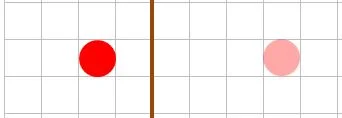
Fig 4
Size and Speed Matter.
Consider a sphere of radius r travelling towards a wall with speed v from a position just out of contact with the wall. To be able to use the intersectsMesh method with certainty, the sphere must be in contact with the wall during the next frame. The maximum distance the sphere can travel between frames must be less than twice the radius, as in Fig 5.
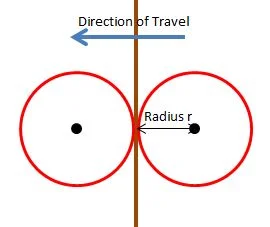
Fig 5
So, for the sphere to start in any random position and travel directly towards the wall, and for an intersection with the wall definitely to take place during a frame, v <= 2r.
Now consider two spheres travelling towards each other, each sphere having a speed v. The relative velocity is 2v. Take one sphere as stationary and the other as moving with speed v from a position just out of contact. To be able to use the intersectsMesh method the spheres must be in contact with each other during the next frame. The maximum distance the moving sphere can travel between frames must be less than four times the radius, as in Fig 6.
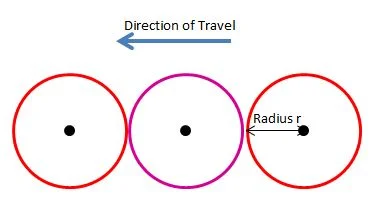
Fig 6
So, for two spheres to start in any random positions and travel directly towards each other, and for an intersection definitely to take place during a frame, 2v <= 4r, which is again v <= 2r.
To generalise, should one sphere have radius r1 and speed v1, and the other radius r2 and speed v2, intersections from random positions will definitely take place
when v1 + v2 < 2(r1 + r2).
What is the situation when v > 2r?
Consider that the front of the sphere is a distance d from the wall in a frame, F, and in the next frame, N, the sphere intersects the wall or has moved past it; then 0 <= d <= v. If d > v, then d - v > 0, and so in the next frame the sphere is still a distance d - v > 0 from the wall. In fact, when the sphere is any distance p away from the wall, p > 0, then for frame F, d = p modulo v. Fig 7 shows that for the sphere to intersect the wall, v - 2r < d < v.
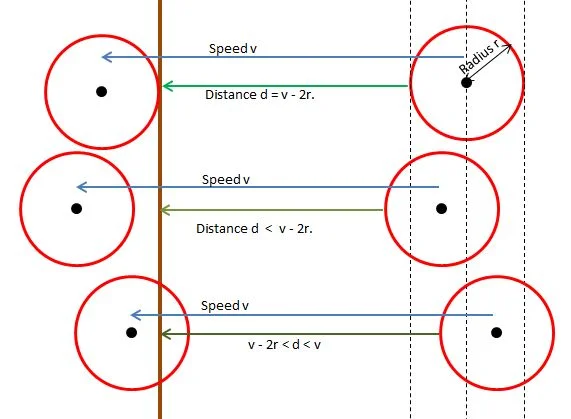
Fig 7
The sphere just touches the wall when d = 0 and so for a display where the sphere does not penetrate the wall p modulo v is 0.
Expressing this in quotient and remainder form p = qv, q >= 0
Since p is the distance from the front of the wall the centre of the sphere will be at qv + r.
Playground Example
In the following playground, the three spheres are positioned so that for sphere1, d < v - r and it will pass through the wall; for sphere2, d = 0; and for sphere3, v - 2r < d < v. The radius and speed for each sphere have been set to the same values but can be changed easily if you wish to. Sphere1 is at the top, sphere2 in the middle, and sphere3 at the bottom.
PG: Spheres Collide With Walls
Hypotheses
Given a multitude of equally sized spheres, all initially inside a box, with random velocities and using Newtonian physics to inform the results of collisions:
-
By setting the initial speed of each sphere to be twice the radius and constraining their initial positions to be within a grid system of cubes with size matching the diameter of the spheres, it is possible to create a system whereby all collisions and rebounds between a sphere and a wall, and between two spheres, take place when they just touch.
-
By setting the initial speed of each sphere to below twice the radius of a sphere, it is possible to form a system whereby all collisions and rebounds between a sphere and a wall, and between two spheres, can be detected by checking whether the meshes intersect.
Both hypotheses turn out to be false. This can be seen by reading the following:
This being the case, we turn to issues arising when the speed of a sphere is greater than twice the radius.
Stroboscopic Issues
What happens when the speed of a sphere is greater than twice the radius and you need to calculate its position following what should be a collision with the wall?
In Fig 8, the red arrow shows the movement of the sphere between two frames when the collision with the wall is not detected, and the green arrow shows the required movement. The required position is a reflection, with the wall as reflector, of the through position.
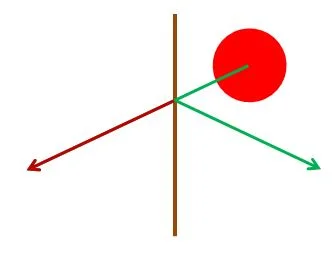
Fig 8.
As usual r is the radius of the sphere.
If a sphere is moving at right angles to a wall from a distance of 8r units, and the speed of the sphere is 16r units, then its reflected position will be its start position and the sphere will appear not to have moved. This is the stroboscopic effect.
The following Playground shows spheres all starting from a distance of 8r units from two walls, all moving at right angles to the walls with speeds ranging from 20r to 12r units.
Conclusion
Depending on the effect required, it is probably better to start with speeds of 2r or below per frame, but even so, using mesh intersections alone is not sufficient to check for collisions, and mathematical techniques will be needed. These techniques will both determine if collisions take place and the repositioning of the spheres.