Rotation Conventions
Transformations
Rotation Conventions
There are several methods of achieving rotations within Babylon.js, and each uses a particular convention.
Euler Angles
In 3D space, Euler angles can produce any possible orientation by providing three angles to rotate about three axes in a given order.
For the three axes X, Y, and Z, there are 12 different permutations for the order of the angles. Since X, Y, and Z can be in World Space or in Local Space, this means there are potentially 24 different possibilities. Most, if not all, of these are used in different systems around the world. So you need to be very clear about the convention used by the system you are working in.
Mesh.rotation(alpha, beta, gamma) uses the three Euler angles alpha, beta and gamma which are rotations about the X, Y and Z axes respectively. The convention that Babylon.js uses is based on the yaw, pitch and roll convention and so is carried out around X, Y and Z in local space in the order Y, X, Z.
References to Euler angles within the Babylon.js community can usually be taken to mean the angles to use with the rotation method.
YXZ Local Axes Yaw, Pitch, Roll
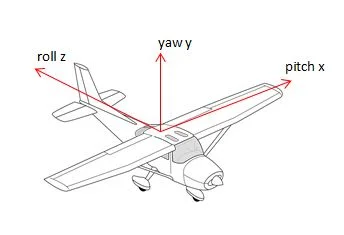
A pitch is about X, yaw about Y, and roll about Z, applied in the order yaw, pitch, roll using local axes.
Applying independent rotations to a newly created mesh (i.e. one that has zero rotations) in the order YXZ using local axes
import { Axis, Space } from "@babylonjs/core/Maths/math.axis";mesh.rotate(Axis.Y, yaw, Space.LOCAL);mesh.rotate(Axis.X, pitch, Space.LOCAL);mesh.rotate(Axis.Z, roll, Space.LOCAL);produces the same orientation as
import { Vector3 } from "@babylonjs/core/Maths/math.vector";mesh.rotation = new Vector3(pitch, yaw, roll);which will produce this orientation regardless of the mesh's orientation before it is applied. The playground below demonstrates this by randomly generating angles and then applying these two methods to two different boxes, which remain in alignment.
YXZ Yaw, Pitch, RollZXY World Axes
The YXZ convention with local axes has produced a particular orientation and it turns out that taking the same angles (alpha = pitch, beta = yaw and gamma = roll) and applying them in the order ZXY in world space will produce exactly the same orientation.
Applying independent rotations to a newly created mesh (i.e. one that has zero rotations) in the order ZXY
import { Axis, Space } from "@babylonjs/core/Maths/math.axis";mesh.rotate(Axis.Z, gamma, Space.WORLD);mesh.rotate(Axis.X, alpha, Space.WORLD);mesh.rotate(Axis.Y, beta, Space.WORLD);produces the same orientation as
import { Vector3 } from "@babylonjs/core/Maths/math.vector";mesh.rotation = new Vector3(alpha, beta, gamma);which will produce this orientation regardless of the mesh's orientation before it is applied. The playground below demonstrates this by randomly generating angles and then applying these two methods to two different boxes, which remain in alignment.
ZXY ExampleEuler Angles to Quaternions
YXZ, Local Space, Yaw, Pitch, Roll
As a reminder, this convention is used directly in the rotation method in Babylon.js in the form
import { Vector3 } from "@babylonjs/core/Maths/math.vector";mesh.rotation = new Vector3(pitch, yaw, roll);In this convention, you take the three angles, yaw, pitch, and roll and rotate yaw about Y, then pitch about X, and roll about Z using the local axes.
import { Axis, Space } from "@babylonjs/core/Maths/math.axis";mesh.rotate(Axis.Y, yaw, Space.LOCAL);mesh.rotate(Axis.X, pitch, Space.LOCAL);mesh.rotate(Axis.Z, roll, Space.LOCAL);which with quaternions is the same as using RotationYawPitchRoll
import { Quaternion } from "@babylonjs/core/Maths/math.vector";const yprQuaternion = Quaternion.RotationYawPitchRoll(yaw, pitch, roll);Applying the above rotate sequence to a newly created mesh (i.e. one that has zero rotations) in the order YXZ in local space, and applying RotationAlphaBetaGamma to a mesh with any orientation using the same angles, will produce the same orientation. The playground below demonstrates this by randomly generating angles and then applying these two methods to two different boxes, which remain in alignment.
Yaw Pitch Roll to QuaternionZXZ, World Space, A Standard Convention
A standard Euler angle convention is to take three given angles alpha, beta, and gamma and rotate alpha about Z, then beta about X, then gamma about Z using the world axes. In Babylon.js, this can be achieved by using rotate
import { Axis, Space } from "@babylonjs/core/Maths/math.axis";mesh.rotate(Axis.Z, alpha, Space.WORLD);mesh.rotate(Axis.X, beta, Space.WORLD);mesh.rotate(Axis.Z, gamma, Space.WORLD);which with quaternions is the same as using RotationAlphaBetaGamma
import { Quaternion } from "@babylonjs/core/Maths/math.vector";var abcQuaternion = Quaternion.RotationAlphaBetaGamma(alpha, beta, gamma);Applying the above rotate sequence to a newly created mesh (i.e. one that has zero rotations) in the order ZXZ in world space, and applying RotationAlphaBetaGamma to a mesh with any orientation using the same angles, will produce the same orientation. The playground below demonstrates this by randomly generating angles and then applying these two methods to two different boxes, which remain in alignment.
ZXZ To QuaternionSo far, we have considered one mesh operating in its local space and in Babylon.js world space. What if we want one mesh to operate in the frame of reference of another mesh? Before we consider parenting in the next section, we will look at ways this can be done using the data that Babylon.js directly stores for a mesh's transformations and coordinates.