# Putting Shader Code Into Babylon.js
> Dive deep into the inner workings of how Babylon.js handles shaders.
Source: https://doc.babylonjs.com/features/featuresDeepDive/materials/shaders/shaderCodeInBjs
## Putting Shader Code in Babylon.js
Here are four ways of putting shader code into your scene:
1. Use [BabylonJS Create Your Own Shader (CYOS)](https://www.babylonjs.com/cyos/) and download a zip file;
2. Write the Vertex and Fragment Shader Code into <script> tags
3. Write, save and import a Vertex and Fragment Shader file of type _.fx_ into your code;
4. Use the shaderBuilder extension of Babylon.js.
Methods 1, 2 and 3 use [BABYLON.ShaderMaterial](https://doc.babylonjs.com/features/featuresDeepDive/materials/shaders/shaderMaterial) to pass data to the shaders.
## Shader preprocessing limitation
Babylon.js preprocesses vertex and fragment shader source before compilation and splits source lines at semicolons. Empty clauses can therefore be lost during preprocessing. For example, the valid GLSL and WGSL loop header `for (;;)` can be transformed into invalid shader code.
This is a limitation of Babylon.js shader processing, not of GLSL or WGSL themselves. Shader generators that emit empty semicolon clauses can be affected. Slang v2026.18.3 and earlier may emit `for (;;)` for unconditional WGSL loops; versions newer than v2026.18.3 emit WGSL's native `loop` construct instead and avoid this specific case.
## Babylon.js CYOS Download
This site allows you to write code for a Vertex Shader and a Fragment Shader and see the results on a variety of meshes.
Downloading a zip file produces a folder containing an _index.html_ file and some image files for texture.
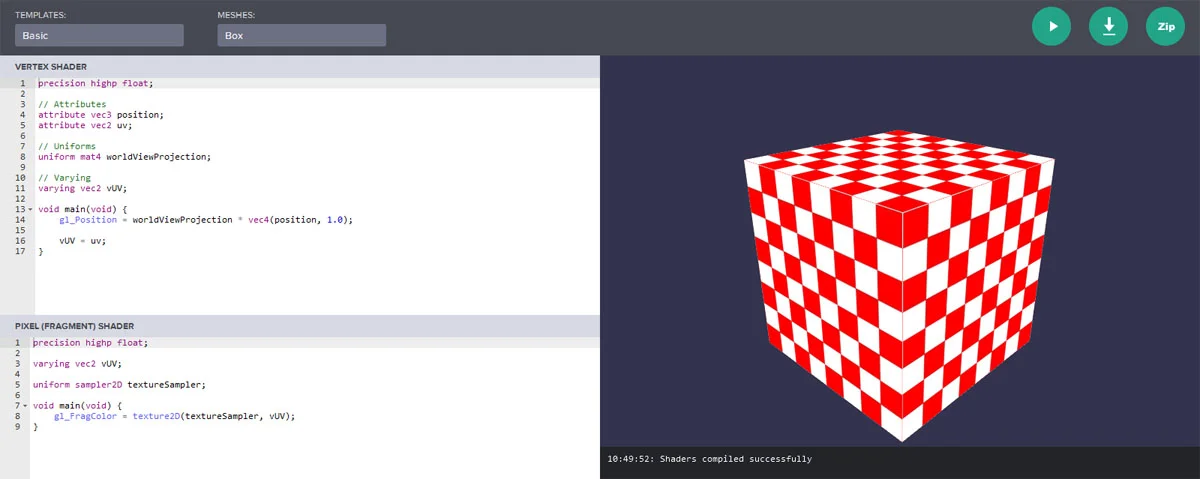
The _index.html_ file contains the shader code in the correct format to apply as a material.
Within the HTML page, the shader code becomes this (in JavaScript):
```javascript
BABYLON.Effect.ShadersStore["customVertexShader"] =
"\r\n" +
"precision highp float;\r\n" +
"// Attributes\r\n" +
"attribute vec3 position;\r\n" +
"attribute vec2 uv;\r\n" +
"// Uniforms\r\n" +
"uniform mat4 worldViewProjection;\r\n" +
"// Varying\r\n" +
"varying vec2 vUV;\r\n" +
"void main(void) {\r\n" +
" gl_Position = worldViewProjection * vec4(position, 1.0);\r\n" +
" vUV = uv;\r\n" +
"}\r\n";
BABYLON.Effect.ShadersStore["customFragmentShader"] = "\r\n" + "precision highp float;\r\n" + "varying vec2 vUV;\r\n" + "uniform sampler2D textureSampler;\r\n" + "void main(void) {\r\n" + " gl_FragColor = texture2D(textureSampler, vUV);\r\n" + "}\r\n";
```
The JavaScript code to use the shader as a material is
```javascript
const shaderMaterial = new BABYLON.ShaderMaterial(
"shader",
scene,
{
vertex: "custom",
fragment: "custom",
},
{
attributes: ["position", "normal", "uv"],
uniforms: ["world", "worldView", "worldViewProjection", "view", "projection"],
},
);
```
and the JavaScript code to set a texture on the material is
```javascript
const mainTexture = new BABYLON.Texture("amiga.jpg", scene);
shaderMaterial.setTexture("textureSampler", mainTexture);
```
and to use the material on a mesh is
```javascript
mesh.material = shaderMaterial;
```
Extracting the appropriate sections of Javascript code allows you to transfer them to your own scenes.
[Guide Example From CYOS Zip](https://babylonjsguide.github.io/examples/cyoszip.html)
This method can easily be used in the Playground.
- [Playground: Playground Example From CYOS](https://playground.babylonjs.com/#1OH09K#131)
## Shader Code in <script> Tags
In the _index.html_ file, the JavaScript code for the shaders is
```javascript
```
The JavaScript code to use the shader as a material becomes
```javascript
const shaderMaterial = new BABYLON.ShaderMaterial(
"shader",
scene,
{
vertexElement: "vertexShaderCode",
fragmentElement: "fragmentShaderCode",
},
{
attributes: ["position", "normal", "uv"],
uniforms: ["world", "worldView", "worldViewProjection", "view", "projection"],
},
);
```
[Guide Example From Script](https://babylonjsguide.github.io/examples/scriptcode.html)
## Shader Code in fx Files
Save your code in two files, one for the Vertex Shader and one for the Fragment Shader.
These files **must** be in the same folder as your _index.html_ page and the names of the files **must** follow this format
COMMON_NAME.vertex.fx
COMMON_NAME.fragment.fx
The JavaScript code to use the shader as a material becomes
```javascript
const shaderMaterial = new BABYLON.ShaderMaterial("shader", scene, "./COMMON_NAME", {
attributes: ["position", "normal", "uv"],
uniforms: ["world", "worldView", "worldViewProjection", "view", "projection"],
});
```
**Note**: `./` is necessary before the `COMMON_NAME`
It is also possible to access the fx files from a URL by giving the full URL,
provided CORS is enabled for them.
[Guide Example From Import](https://babylonjsguide.github.io/examples/importcode.html)
## Shader Includes
When building shaders, you sometimes have parts of your code that will be reused between multiple shaders. These are usually things like reused uniforms, functions, structs, and so on. A powerful way to handle this is:
```javascript
BABYLON.Effect.IncludesShadersStore["includeName"] = "...";
```
The includes already contain common shader elements for Babylon's StandardMaterial, PBR materials, ProceduralTextures, and more. See the Github [https://github.com/BabylonJS/Babylon.js/tree/master/packages/dev/core/src/Shaders/ShadersInclude](https://github.com/BabylonJS/Babylon.js/tree/master/packages/dev/core/src/Shaders/ShadersInclude) for a complete list of shader includes packaged with BJS.
Additionally, you can add anything you want to the `IncludesShadersStore` before or after scene compilation. To access these includes, simply call:
```glsl
#include
```
Add this in the appropriate section of your shader code to have it injected into your shader when it is compiled [see example](https://www.babylonjs-playground.com/#0MAYNY).
## Shader Builder
This is an extension to Babylon.js. Copy and save the [source code](https://github.com/BabylonJS/Extensions/blob/master/ShaderBuilder/Babylonx.ShaderBuilder.js) for the extension and add it as
```javascript
```
The Shader Builder engine needs to be initialised
```javascript
BABYLONX.ShaderBuilder.InitializeEngine();
```
The format for writing a ShaderBuilder is **fluent coding**, and it deals with attributes and Babylon.js uniforms automatically.
An example equivalent to the shader code used in methods 1 to 3 above would be
```javascript
mesh.material = new BABYLONX.ShaderBuilder().Map({ path: "textures/amiga.jpg" }).BuildMaterial(scene);
```
[Guide Example using ShaderBuilder](https://babylonjsguide.github.io/examples/basiccodeSB.html)
This method can be used in the Playground. However, it does require loading the ShaderBuilder JavaScript file and an `onLoad`
function before it can be called.
- [Playground: Playground Example Using ShaderBuilder](https://playground.babylonjs.com/#NCY1Q#36) - Playground example using shaderbuilder.
## Further reading
- [Introduction To Shaders in Babylon.js](https://doc.babylonjs.com/features/featuresDeepDive/materials/shaders/introToShaders)
- [ShaderMaterial Object](https://doc.babylonjs.com/features/featuresDeepDive/materials/shaders/introToShaders)